

Most businesses treat paid ads and organic content as two separate budgets. For a long time, that worked. You paid for immediate visibility, and you built content for long-term authority.
But the way customers search is changing, and the old model is breaking down.
We are seeing a clear shift in how leadership teams allocate their marketing budgets. They are moving away from a total reliance on paid search and display ads, and they are moving toward a more balanced marketing mix that prioritizes AI content development. This is not a trend. It is a necessary response to how AI search engines and generative models are reshaping customer discovery.
If your website cannot clearly explain what you do, why you are credible, where you serve customers, and what someone should do next, AI systems have very little reason to reference you. And if they do not reference you, your paid ads have to work twice as hard to capture shrinking real estate.
Why Paid Ads Are Losing Ground
From my point of view, here is how you can think about this shift. The traditional search engine results page (SERP) is being compressed.
When a user asks a question, AI Overviews and conversational AI models often provide the answer directly at the top of the page. According to a recent analysis by LLMrefs, more than 80 percent of searches now end without a user clicking on a website. This zero-click search behavior means that the original search query is satisfied immediately.
For paid search, this creates a significant problem. Fewer impressions reach the positions where search ads typically run. In a recent study from Seer Interactive shows that while behavior is starting to stabilize into a “new normal,” the impact remains stark. Paid CTR when an AI Overview is present has leveled out at approximately 16.2 percent, compared to 21.8 percent for queries where no AI Overview is shown. While this is a slight recovery from previous lows, it still represents a fundamental shift in how users engage with the page.
Furthermore, a recent large-scale measurement study of Google AI Overviews found that these AI-generated answers are activated on 13.7 percent of all queries, but that number jumps to 64.7 percent for question-form queries. The study also noted that over half of the pages cited by AI Overviews carry display advertising, meaning publishers are losing revenue when AI suppresses the click-through.
When AI answers the question, the user does not scroll down to click your ad. Your paid media budget is suddenly competing for a much smaller slice of attention, which drives up the cost per click and lowers your return on ad spend (ROAS).
The Rise of AI Content Development
This is why we are seeing a shift toward AI content development. Businesses are realizing that they cannot just buy their way to the top of the page anymore. They have to earn their way into the AI’s understanding of the market.
AI content development is not about using ChatGPT to write hundreds of generic blog posts. That is a shortcut, and shortcuts do not build authority.
Real AI content development is about structuring your expertise so that AI systems can read, understand, and cite it. We are seeing a fundamental transition where marketing dollars are moving away from simple website maintenance and toward building content that is intentionally geared for Large Language Models (LLMs). This is the evolution of organic search. It is about creating high-value, human-generated content that provides real utility to readers while being structured so that AI systems can easily parse and reference it.
When Google Gemini or Microsoft Copilot synthesizes an answer, it looks for structured, authoritative sources. If your content is built correctly, your brand becomes the citation. And the data shows this matters. The Seer Interactive study found that being cited in an AI Overview delivers 120 percent more organic clicks per impression compared to when a brand is not cited. Brand authority, AI visibility, and paid performance are now deeply connected.
Building a Balanced Marketing Mix
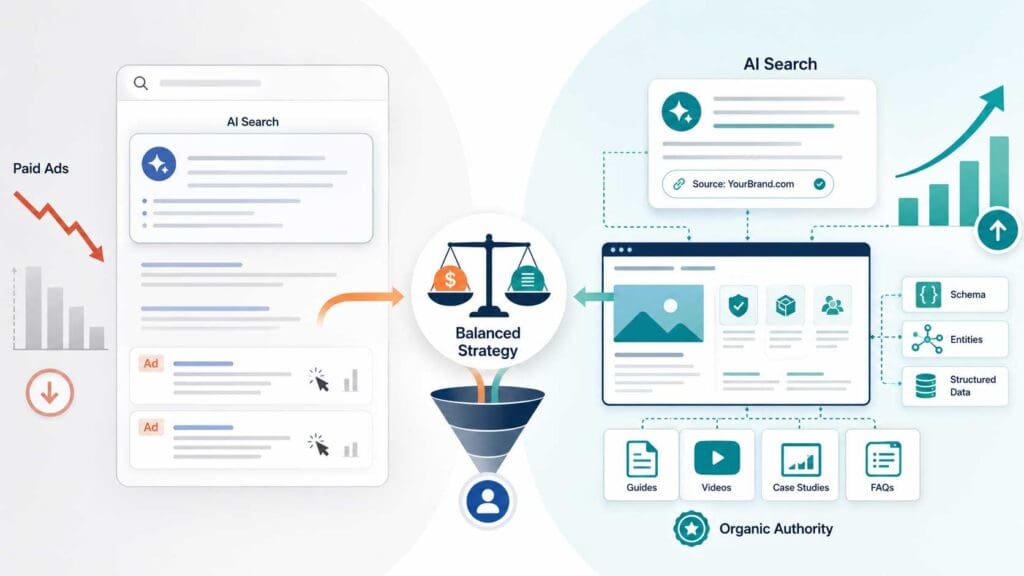
We do not advise clients to turn off their paid ads. Paid search and display still play a critical role in a connected acquisition ecosystem, especially for bottom-of-funnel, high-intent queries.
But total reliance on paid ads is a fragile strategy.
The businesses that will win in this new environment are the ones that build a balanced marketing mix. They use paid ads to capture immediate commercial intent, but they invest heavily in AI content development to build structured visibility and topical authority.
This means shifting budgets to focus on:
- Structured Service Pages: Clear, detailed pages that explain exactly what you do and where you do it, supported by schema markup.
- Question-Based Content: Content that directly answers the complex, multi-step questions your buyers are asking AI models.
- First-Party Data: Using your CRM and customer data to inform your content strategy and refine your paid targeting.
Strategy Still Wins
AI is changing discovery, but it has not eliminated the need for strategy. It has only made weak strategy easier to expose.
Take a look at your current marketing budget. If you are spending heavily on paid ads but ignoring how your content is structured for AI search, you are likely experiencing revenue leakage. Start by auditing your core service pages. Ensure they are structured not just for human readers, but for the AI systems that are increasingly acting as the gatekeepers to your audience. Build a system that drives growth, rather than relying on isolated tactics.